
Every UAV power system design starts with the same decision: which cell format to build around. The answer depends on physics and system requirements — not on convention or supplier availability. Yet in practice, the choice between pouch cells and cylindrical cells is rarely made on the basis of measured data. Most engineers default to what they know, or what their previous supplier offered.
Cylindrical cells are constructed by winding electrode layers into a spiral and enclosing them in a rigid steel or aluminum can. The most common formats for UAV applications are the 18650 (18 mm diameter, 65 mm length) and the 21700 (21 mm diameter, 70 mm length). That metal casing accounts for roughly 8–12% of the cell’s total mass — dead weight that contributes nothing to energy storage.
Pouch cells, sometimes called soft-pack or LiPo cells, use stacked flat electrode layers sealed in a laminated aluminum foil pouch with a wall thickness of approximately 0.1 mm, compared to the 0.25–0.4 mm metal casing of cylindrical formats. The housing mass drops to 2–3% of total cell weight. The remaining mass is active material — cathode, anode, and electrolyte — where the energy actually lives.
Both formats can use identical cathode chemistries: NMC (Nickel Manganese Cobalt), NCA, and others. What changes with the format is structure, not chemistry. A prismatic cell — rectangular and metal-cased — occupies a middle ground between the two but is rarely used in high-rate UAV applications due to its weight overhead and limited customizability.
The table below compares measured data from high-rate cylindrical cells currently available for UAV applications against the ampKRAFT PS3 Series pouch cells. All cylindrical values are sourced from manufacturer datasheets for the leading high-drain 21700-class cells; PS3 values are from the ampKRAFT cell datasheets (REV A0, March 2026).
| Parameter | High-Rate Cylindrical (21700 class) | PS3 Series Pouch Cells (ampKRAFT) |
|---|---|---|
| Max. continuous discharge | 12.5C (best-in-class, Ev 40P) | 15C — consistent across all models |
| Burst discharge (10 s) | ~15C (typical) | 20C across all models |
| Energy density range | 212–257 Wh/kg | 247–256 Wh/kg |
| Capacity range per cell | 4,000–5,000 mAh | 10,600–21,200 mAh |
| Weight per cell | 67–70 g | 136–272 g |
| Casing mass fraction | ~8–12% of total | ~2–3% of total |
| Cell width (pack geometry) | Fixed (21 mm diameter) | 70.5 mm — consistent across all PS3 formats |
| AC impedance at 1 kHz | Varies by model | ≤ 2.5 mΩ across all models |
| Discharge temperature range | Typically −20 °C to +60 °C | −20 °C to +60 °C |
Three data points stand out. First, the PS3 Series delivers 15C continuous across all five cell models — from the 10,600 mAh format up to the 21,200 mAh format. No cylindrical cell in this comparison reaches 15C on a continuous basis; the best available 21700 peaks at 12.5C. At a pack level, this translates to a 20% higher continuous current capability per unit of cell mass.
Second, the energy density overlap is real but nuanced. The cylindrical range (212–257 Wh/kg) spans a wide band because it mixes high-rate and energy-type cells. High-rate cylindrical cells — the only relevant comparison for UAV applications above 10C — cluster at the lower end of that range (212–231 Wh/kg). The PS3 pouch cells sit consistently at 247–256 Wh/kg. That is not a marginal difference: at the pack level, it compounds with the weight saved by fewer cells and simpler interconnects.
Third, the capacity range per cell is structurally different. A single PS3 cell carries 10,600–21,200 mAh. The best 21700 cell reaches 5,000 mAh. This is not a performance specification — it is a structural constraint that defines how complex a pack must be to reach a given capacity target.
High capacity with cylindrical cells requires parallel configurations. A 16 Ah pack built on 4,000 mAh 40P cylindrical cells needs four cells in parallel before any series configuration is added. The same 16 Ah target is reached by a single PS3 FBC11671125PS3 pouch cell (16,000 mAh nominal).
Every additional parallel connection is a potential failure point in production and in the field. Parallel buses add weight through nickel or copper interconnects, require tighter cell matching to prevent current imbalance, and increase the BMS complexity needed to maintain cell balance over the pack’s lifecycle. At the system level, a higher parallel count means that cell variance — which exists in any manufacturing process — has a greater impact on pack behavior.
When a UAV manufacturer scales capacity upward, say from a 10 Ah platform variant to a 20 Ah variant, the cylindrical pack grows in parallel count and assembly complexity. The pouch pack grows in cell thickness or length, while the mechanical integration stays largely identical. This matters for production planning: the tooling, fixtures, and assembly process developed for one pouch-cell pack configuration transfers directly to the next capacity tier. With cylindrical cells, each capacity step is a new assembly architecture.
Heat management in a battery pack operating at 15C continuous is not a secondary concern. At those current densities, cell temperature directly affects cycle life, capacity retention, and safety margins.
Pouch cells dissipate heat across their entire flat surface area. With stacked flat electrodes and a thin laminate housing, there is no thermal bottleneck at a sealed metal end cap. Cylindrical cells concentrate heat at the electrode tabs within the metal can, and the can itself acts as a partial thermal barrier — heat must conduct through the cell wall before it can reach the surrounding structure or airflow.
For UAV applications where high-current discharge events are frequent and thermal management is limited to passive convection (no active cooling in the pack), this difference has measurable consequences for degradation rates. The PS3 Series operates within a discharge temperature range of −20 °C to +60 °C — covering the full envelope of agricultural operations in summer conditions, industrial inspection environments, and cold-weather deployments. Cycle life testing at 6C discharge shows capacity retention above 80% across the tested cycle range for all PS3 models.
One honest engineering note: pouch cells require mechanical containment in the pack to accommodate cell swelling over service life. This adds design complexity that cylindrical cells — which maintain fixed outer dimensions — do not require. A well-designed pouch cell enclosure compensates for this with compression plates or foam inserts. It is not a fundamental disadvantage, but it is a real engineering task that must be accounted for in pack design.
Cylindrical cells are available in two standard formats for UAV applications: 18650 and 21700. No manufacturer produces these in alternative diameters. UAV designers working with cylindrical cells must therefore build their battery compartments around a fixed cell geometry, accepting whatever space is left over as dead volume. Cylindrical packing in a rectangular enclosure leaves approximately 10% of the total compartment volume unused — a geometric constraint, not an engineering choice.
Pouch cells are manufactured to specified dimensions. Within a given cell family, consistent outer width across capacity tiers allows modular pack design. All five PS3 Series cell models share a 70.5 mm cell width. A UAV manufacturer developing a platform family across multiple payload classes can use the same mechanical battery tray design across all variants, changing only cell length or thickness as capacity scales. This directly reduces non-recurring engineering cost when developing derivative platforms.
Packing efficiency for rectangular pouch cells in a rectangular enclosure approaches 99%. Every gram of housing mass saved by the more efficient packing translates directly to available payload or extended flight time — which are the two metrics that determine commercial viability in industrial UAV applications.
A fair technical comparison must include the cases where cylindrical cells remain the right engineering choice. Three scenarios apply in the professional UAV context.
For platforms with low continuous discharge requirements — 3–5C — and high cycle count targets above 1,000 cycles, cylindrical LFP cells offer a well-documented combination of cycle stability and mechanical robustness. The metal housing resists puncture and deformation under shock loading in a way that pouch cells, without a protective enclosure, do not. For UAVs operating in high-vibration environments where the battery compartment cannot provide full mechanical containment, the rigid cylindrical format has a structural advantage.
Additionally, manufacturers who have already qualified a cylindrical cell-based pack assembly process — including cell matching, BMS calibration, and thermal validation — face real switching costs when moving to a different format. Those costs are one-time and quantifiable, but they are not zero. The technical case for pouch cells does not eliminate the practical case for considering total transition cost in a sourcing decision.
Cylindrical cells are an engineering-valid choice in specific operational contexts. For high-rate, weight-critical professional UAV platforms, the tradeoffs consistently favor the pouch format.
The table below maps common platform requirements to the format that the data supports. It is not a recommendation in the abstract — it is a starting point for quantifying the tradeoffs against your specific airframe and mission envelope.
| If your platform requires… | Recommended format | Rationale |
|---|---|---|
| Continuous discharge > 10C | Pouch Cell | 15C continuous vs. 12.5C best-in-class cylindrical |
| Weight-optimized airframe | Pouch Cell | 2–3% housing mass vs. 8–12%; higher usable energy per gram |
| Scalable capacity across platform variants (10–22 Ah) | Pouch Cell | Consistent 70.5 mm cell width — same mechanical tray, different cell length |
| Pack assembly simplicity / low cell count | Pouch Cell | Single-cell parallel configurations; no parallel bus required at capacity |
| High cycle count (>1,000 cycles) at 3–5C | Evaluate Cylindrical (LFP) | LFP cylindrical well-documented for cycle stability at moderate rates |
| High mechanical shock / vibration, no enclosure | Cylindrical | Metal casing resists puncture without additional housing |
| OEM cell sourcing with custom dimensions | Pouch Cell | Pouch format manufacturable to specified dimensions; cylindrical formats are fixed |
| Defense / traceability requirements | Pouch Cell | Batch-level traceability available; consistent cell family simplifies qualification |
The ampKRAFT PS3 Series covers the high-rate, weight-critical cases in this matrix. Five cell models share the same 70.5 mm cell width, 3.6 V nominal voltage, and ≤2.5 mΩ AC impedance — a consistent cell family designed for integration across platform sizes rather than as isolated SKUs. Cell specifications for all PS3 models are available for download from the Battery Cells page. Finished 6S and 8S soft-pack assemblies built on PS3 cells are listed on the Soft Pack Batteries page.
The following table lists the finished soft-pack battery assemblies built on PS3 cells. All configurations use QS8-S as the primary discharge connector (except FBC7871125PS3 6S1P which uses XT90), and JST-XHP-7P Reversed (6S) or JST-XHP-9P Reversed (8S) as the balancer connector.
| Model | Config | Capacity | Voltage | Cont. Discharge | Energy | Weight |
|---|---|---|---|---|---|---|
| FBC7871125PS3 | 6S1P | 10,600 mAh | 21.6 V | 88 A | 238 Wh | 880 g |
| FBC7871125PS3 | 6S2P | 21,200 mAh | 21.6 V | 130 A | 475 Wh | 1,760 g |
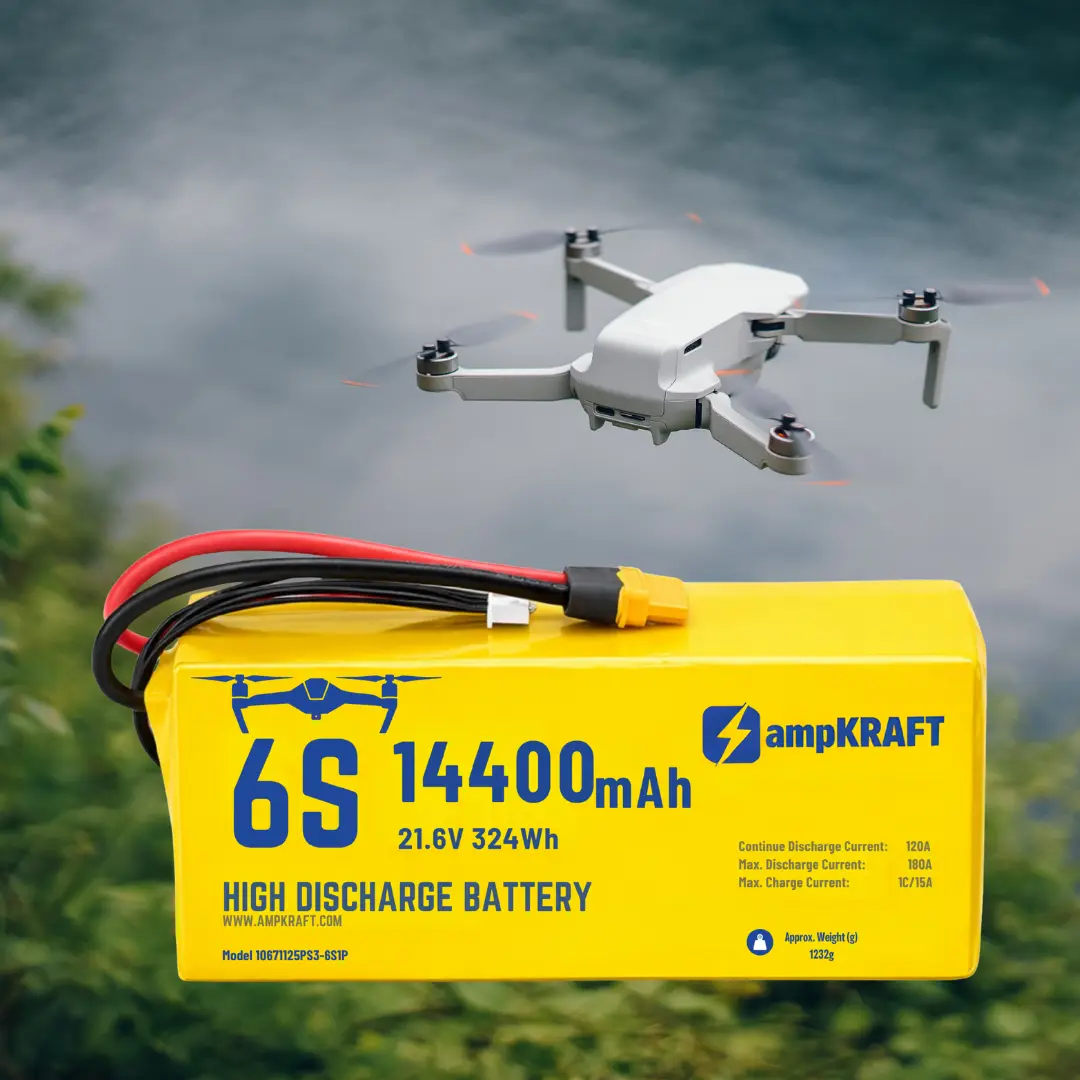
| FBC10671125PS3 | 6S1P | 14,400 mAh | 21.6 V | 120 A | 324 Wh | 1,232 g |
| FBC11671125PS3 | 6S1P | 16,000 mAh | 21.6 V | 130 A | 361 Wh | 1,350 g |
| FBC10171170PS3 | 6S1P | 19,200 mAh | 21.6 V | 130 A | 432 Wh | 1,602 g |
| FBC11071170PS3 | 6S1P | 21,200 mAh | 21.6 V | 130 A | 475 Wh | 1,752 g |
| FBC10171170PS3 | 8S1P | 19,200 mAh | 28.8 V | 130 A | 576 Wh | 2,096 g |
| FBC11071170PS3 | 8S1P | 21,200 mAh | 28.8 V | 130 A | 634 Wh | 2,296 g |
For professional UAV platforms operating above 10C continuous discharge, the pouch cell format delivers a measurable advantage across every parameter that determines system-level performance: higher continuous discharge rate, better gravimetric energy density at the relevant C-rates, lower pack complexity at high capacities, and airframe-friendly geometry. The structural reasons for this are straightforward — 2–3% housing mass instead of 8–12%, stacked flat electrodes instead of wound cylindrical geometry, and single-cell capacity that eliminates parallel buses at most UAV capacity targets.
Cylindrical cells remain valid for specific applications: high-cycle, low-rate platforms and environments where mechanical robustness without a housing is required. For the majority of professional UAV power system specifications, the data points in one direction.
PS3 Series cell datasheets and soft-pack assembly specifications are available on request. If you are qualifying cells for a new platform or evaluating a pack change, contact the ampKRAFT engineering team directly.
Both pouch cells and cylindrical cells use lithium-ion chemistry — the difference is structural, not chemical. A cylindrical cell winds its electrode layers into a spiral and encloses them in a rigid steel or aluminum can. That metal casing accounts for roughly 8–12% of the cell’s total mass without contributing to energy storage. A pouch cell stacks flat electrode layers and seals them in a laminated aluminum foil housing approximately 0.1 mm thick, reducing the non-active housing mass to 2–3% of total cell weight. For a UAV engineer, this means more of every gram goes toward energy output rather than structural packaging. The terms “LiPo” and “soft pack” refer to the pouch format — they describe the housing, not a separate chemistry.
Three reasons dominate in professional UAV applications. First, pouch cells deliver higher continuous discharge rates: the ampKRAFT PS3 Series sustains 15C continuous across all five cell models, while the best available high-rate 21700 cylindrical cell peaks at 12.5C. At a pack level, that translates to meaningfully higher available current per unit of cell mass. Second, reaching high pack capacities with cylindrical cells requires multiple cells in parallel — a 16 Ah cylindrical pack needs four 4,000 mAh cells in parallel, while a single 16,000 mAh pouch cell achieves the same capacity alone. Fewer parallel connections mean fewer weld points, simpler BMS requirements, and lower failure probability. Third, pouch cells can be manufactured to custom dimensions, allowing UAV designers to build battery compartments optimized for their airframe rather than constrained by fixed cylindrical form factors.
For platforms requiring more than 10C continuous discharge, the data supports pouch cells. The highest-performing 21700 cylindrical cells available — formats like the Molicel P50B or Samsung 40T — reach 12–12.5C continuous at their rated capacity of 4,000–5,000 mAh. The ampKRAFT PS3 Series pouch cells deliver 15C continuous at capacities from 10,600 mAh to 21,200 mAh, with a 20C burst rating for 10 seconds. Beyond discharge rate, the gravimetric energy density of the PS3 Series sits at 247–256 Wh/kg — above the high-rate cylindrical range of 212–231 Wh/kg at comparable C-rates. For platforms where weight and discharge capability are both constrained, 18650 and 21700 cells reach their limits earlier than large-format pouch cells.
The C-rating expresses discharge current as a multiple of the cell’s nominal capacity. A 15C continuous rating on a 19,200 mAh (19.2 Ah) cell means it can sustain 15 × 19.2 A = 288 A continuously without thermal damage or accelerated degradation. On a 6S1P pack built around that cell, 288 A at 21.6 V delivers approximately 6.2 kW of continuous power output. For context, a heavy-lift agricultural UAV with four high-power motors drawing 30 A each at peak load requires 120 A from the pack — well within the 288 A ceiling. The practical consequence of a higher C-rating is thermal headroom: a pack running at 5C on a 15C-rated cell stays cooler than the same pack on a 10C-rated cell, which directly extends cycle life and maintains capacity retention over time.
Cylindrical cells are the more appropriate choice in three specific scenarios. First, for platforms with low continuous discharge requirements — 3–5C — and high cycle count targets above 1,000 cycles, lithium iron phosphate (LFP) cylindrical cells are well-documented for cycle stability and offer robust mechanical properties without requiring a protective enclosure. Second, in applications with high mechanical shock or vibration loads where the battery housing cannot provide full containment, the rigid metal casing of a cylindrical cell provides inherent protection against puncture that a bare pouch cell does not. Third, if a UAV manufacturer has already qualified a cylindrical cell-based pack — including BMS calibration, thermal validation, and production tooling — the switching cost to a different format is real and should be factored into any sourcing decision. The structural advantages of pouch cells are most pronounced at high discharge rates and in weight-critical designs.
Cylindrical cells are available in exactly two standard diameters relevant to UAV applications: 18 mm (18650) and 21 mm (21700). UAV designers must build their battery compartments around these fixed dimensions, accepting geometrically unavoidable dead space of approximately 10% in any rectangular enclosure. Pouch cells can be specified to custom dimensions, and within a consistent cell family, outer width stays constant across capacity tiers. All five models in the ampKRAFT PS3 Series share a 70.5 mm cell width — only length and thickness change as capacity scales from 10,600 mAh to 21,200 mAh. This means a UAV manufacturer developing a platform family across multiple payload classes can use the same mechanical battery tray design for every variant, changing the cell but not the airframe interface. Packing efficiency for rectangular pouch cells in a rectangular enclosure approaches 99%, versus roughly 90% for cylindrical cells — a difference that compounds at the system level when every gram of housing and dead volume could otherwise be payload.
You are currently viewing a placeholder content from Vimeo. To access the actual content, click the button below. Please note that doing so will share data with third-party providers.
More InformationYou are currently viewing a placeholder content from YouTube. To access the actual content, click the button below. Please note that doing so will share data with third-party providers.
More InformationYou need to load content from reCAPTCHA to submit the form. Please note that doing so will share data with third-party providers.
More InformationYou need to load content from hCaptcha to submit the form. Please note that doing so will share data with third-party providers.
More InformationYou need to load content from reCAPTCHA to submit the form. Please note that doing so will share data with third-party providers.
More InformationYou need to load content from reCAPTCHA to submit the form. Please note that doing so will share data with third-party providers.
More InformationYou need to load content from reCAPTCHA to submit the form. Please note that doing so will share data with third-party providers.
More InformationYou need to load content from Turnstile to submit the form. Please note that doing so will share data with third-party providers.
More Information